SOUND
Level is not the whole dose.
Meaning, predictability, duration, control and sensitivity shape an encounter. Noise research supports arousal and task-interference mechanisms. It cannot support a diagnosis from a soundtrack.
PACKAGE AAN-F-005 · FIELD INTENSITY
Clocks, rooms, sound, light, bodies, cameras, judgment, labor and recovery move together. The nervous system meets that whole stack. There is no special “Fashion Week circuit” to point to.
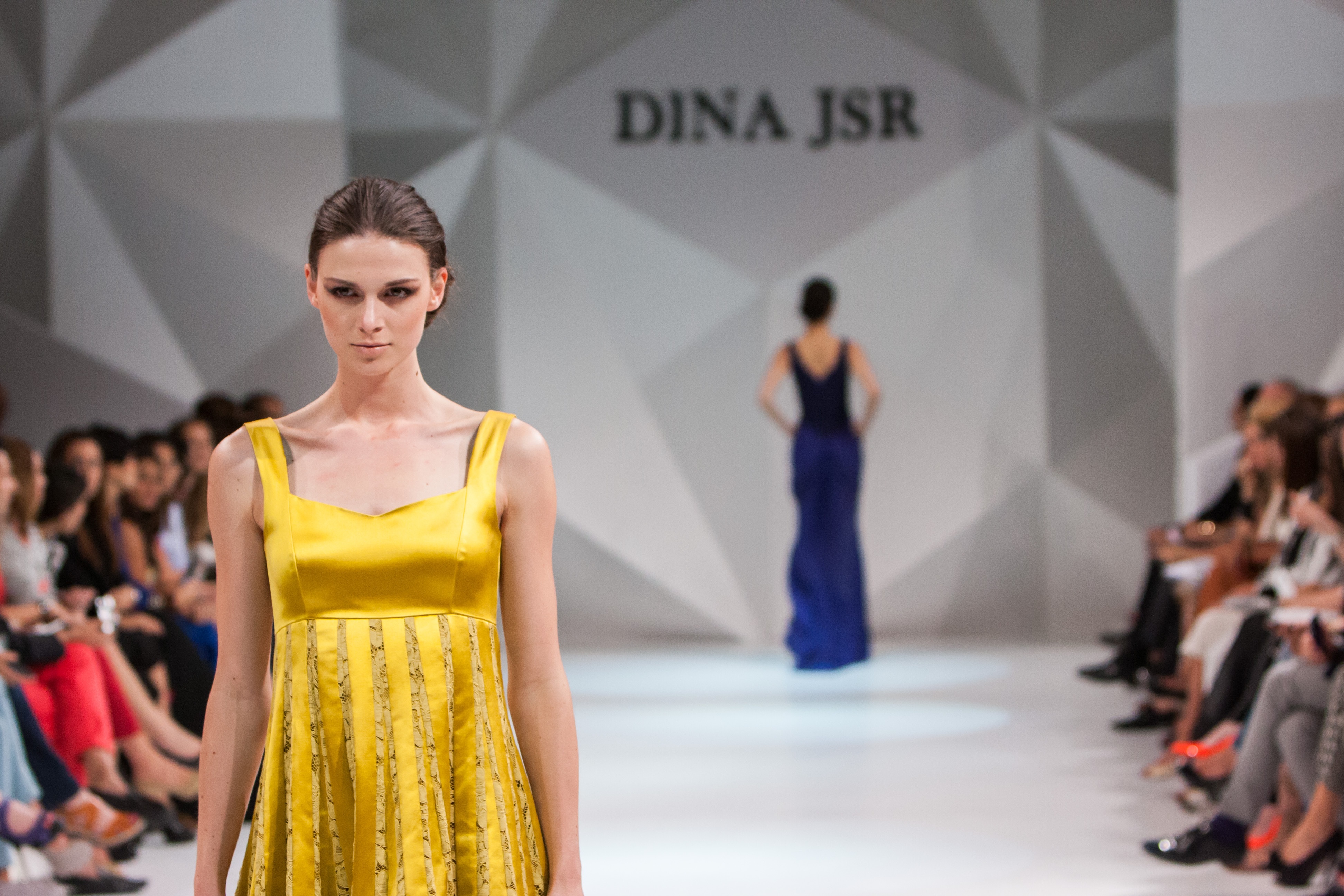
ONE ROOM · MANY INPUTS
The photograph makes lighting, distance, audience density and movement paths visible. It cannot tell us what anyone felt or what their nervous system did.
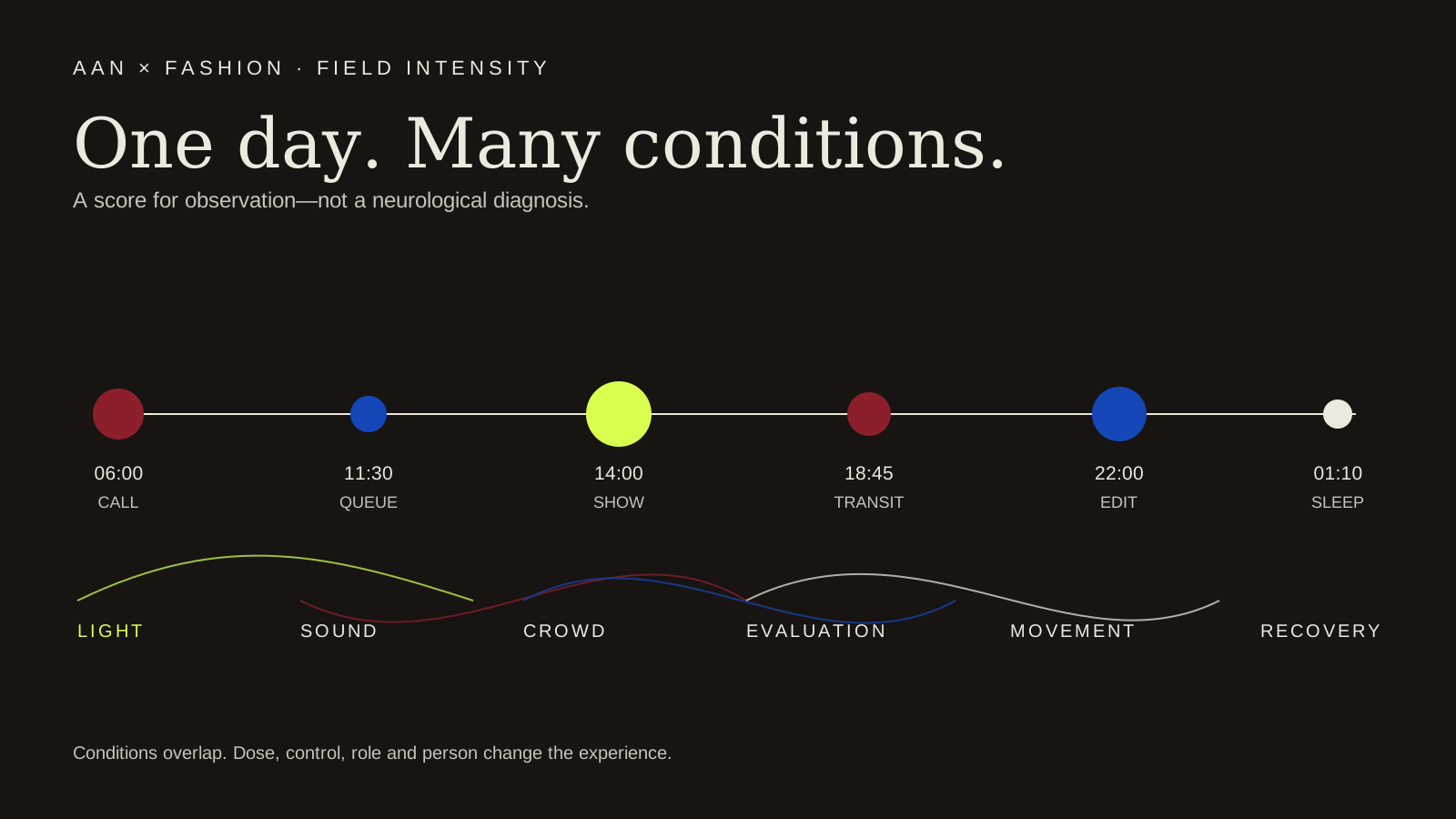
THE FIELD OBJECT
Move through an official 360-degree London Fashion Week record. Notice movement, proximity, changing viewpoints and layered attention. The camera does not measure anyone’s nervous system.
British Fashion Council, 2018. Authorized YouTube privacy-enhanced embed; no download or derivative. Open official video ↗
01
Early calls, late edits, travel and compressed schedules can reduce sleep opportunity. Sleep-deprivation and occupational evidence make one point sturdy: insufficient sleep and long waking periods can degrade vigilance and increase lapses. They do not let us calculate the effect of one schedule on one attendee.
Light matters through timing, spectrum, intensity and duration. A runway spotlight is not a laboratory light protocol. The honest claim is narrower: evening light can alter alertness and circadian physiology, and people vary substantially in sensitivity.
Sleep review ↗ · Human light review ↗ · NIOSH work-schedule course ↗
SOUND
Meaning, predictability, duration, control and sensitivity shape an encounter. Noise research supports arousal and task-interference mechanisms. It cannot support a diagnosis from a soundtrack.
LIGHT
Brightness at noon and at midnight is not the same biological event. A photograph cannot recover spectral exposure.
CROWD
Controlled crowd studies link denser, slower movement with greater arousal. A venue-specific inference still requires measurement.
02
Peripheral motion, music, faces, garments, camera cues and navigation compete. Attention is selective. Stress can bias what becomes salient, while sleep loss can make sustained attention less reliable. Intensity is not harmful in itself. Arousal may feel energizing, pleasurable, focusing or tiring, and it can change across the day.
Overwhelmed, exhilarated and exhausted are descriptions. None is a brain scan.
Noise and cognitive performance review ↗ · Mobile EEG crowd-scene study ↗
WORK BEHIND THE ATMOSPHERE
This official BFC episode makes preparation, coordination and evaluation visible. It cannot reveal sound dose, fatigue, stress hormones or anyone’s private experience.
Authorized YouTube privacy-enhanced embed; no download or derivative. Open official video ↗
03
Fashion Week redistributes looking: casting, seating, photography, critique, recognition and exclusion. Standardized laboratory social-evaluation tasks can elicit cortisol and subjective stress responses. They set a boundary for the mechanism. They do not give permission to call every runway, review or networking exchange a threat response.
Control and role matter. Choosing a loud room differs from being unable to leave it. Model, dresser, producer, photographer, editor, buyer, student and guest do not inhabit the same event.
Social stress-test review ↗ · Crowd density, speed and stress study ↗
04
Standing, walking, waiting, carrying, changing footwear and constrained postures accumulate. Occupational evidence links prolonged standing with discomfort and fatigue, but Fashion Week-specific exposure depends on person, role, duration, breaks and environment.
Recovery begins with observation, before any optimization theater: what load occurred, what can change, and what actually helped? Sleep opportunity, food, water, quieter intervals, sitting, removing pressure, predictable transit and fewer commitments are ordinary supports, and none of them counts as treatment.
WATCH · LISTEN · LEARN
BFC’s 360-degree record is an authorized embed. Nothing is downloaded.
Open on YouTube ↗WHO’s environmental-noise guideline explains why dose and source context matter.
Open guideline ↗NIOSH’s free course addresses work organization as well as individual behavior.
Open course ↗CLAIM LEDGER · FASHION WEEK TRANSFER BOUNDARIES
THE FITTED CLAIM
Sleep loss, timed light, sound, crowd density, social evaluation and prolonged standing can affect attention, arousal or fatigue in studied contexts.
A Fashion Week day can combine those conditions, with responses varying by person, role, control and dose.
A Fashion Week-specific circuit, universal overload, diagnosis, or one recovery prescription.