Music and memory
Janata’s public research record and primary studies.
Open research ↗PACKAGE AAN-F-004 · MEMORY WARDROBE
Why fashion nostalgia can feel immediate, bodily and strangely alive, and why remembering your own life differs from longing for an era you never lived.

THE SHORT ANSWER
Clothing can bind sight, touch, movement, smell, social setting and self-story into one retrieval cue. The feeling is real. The memory itself is rebuilt each time you recall it.
Map one memory garment →01
The graduation jacket, a parent’s scarf, the shirt worn through one summer: if a garment was present when an experience was encoded, its color, weight, cut or smell can later help assemble autobiographical knowledge into a remembered scene. The fabric itself holds no file of the episode.
Autobiographical remembering recruits distributed processes for episodic detail, self-reflection, imagery, attention and emotion. Encoding specificity adds a crucial restraint: cues work through overlap with what was encoded. Nothing is stored inside the object.
A garment may open the door. It does not certify what comes through it.
Svoboda, McKinnon & Levine (2006), open review ↗ · Tulving & Thomson (1973), DOI ↗
MEMORY IS CONSTRUCTIVE
Emotion can intensify the lived quality of recall and influence which episodes are rehearsed. Yet confidence, sensory detail and emotional force do not guarantee historical accuracy. Personal testimony deserves respect without being mislabeled as a verified record.
Holland & Kensinger (2010), emotion and autobiographical memory ↗
02
A song from the dressing room, perfume held in a collar, the light of a childhood bedroom: cues combine. Janata’s music studies show familiar songs can evoke autobiographical memories and strong emotion. Odor-cue experiments find especially emotional, often earlier memories. Neither proves fashion has a proprietary memory circuit.
Janata (2009), PubMed ↗ · Herz & Schooler (2002), DOI ↗ · Barrett et al. (2010), music-evoked nostalgia ↗

OBJECT ≠ YOUR MEMORY
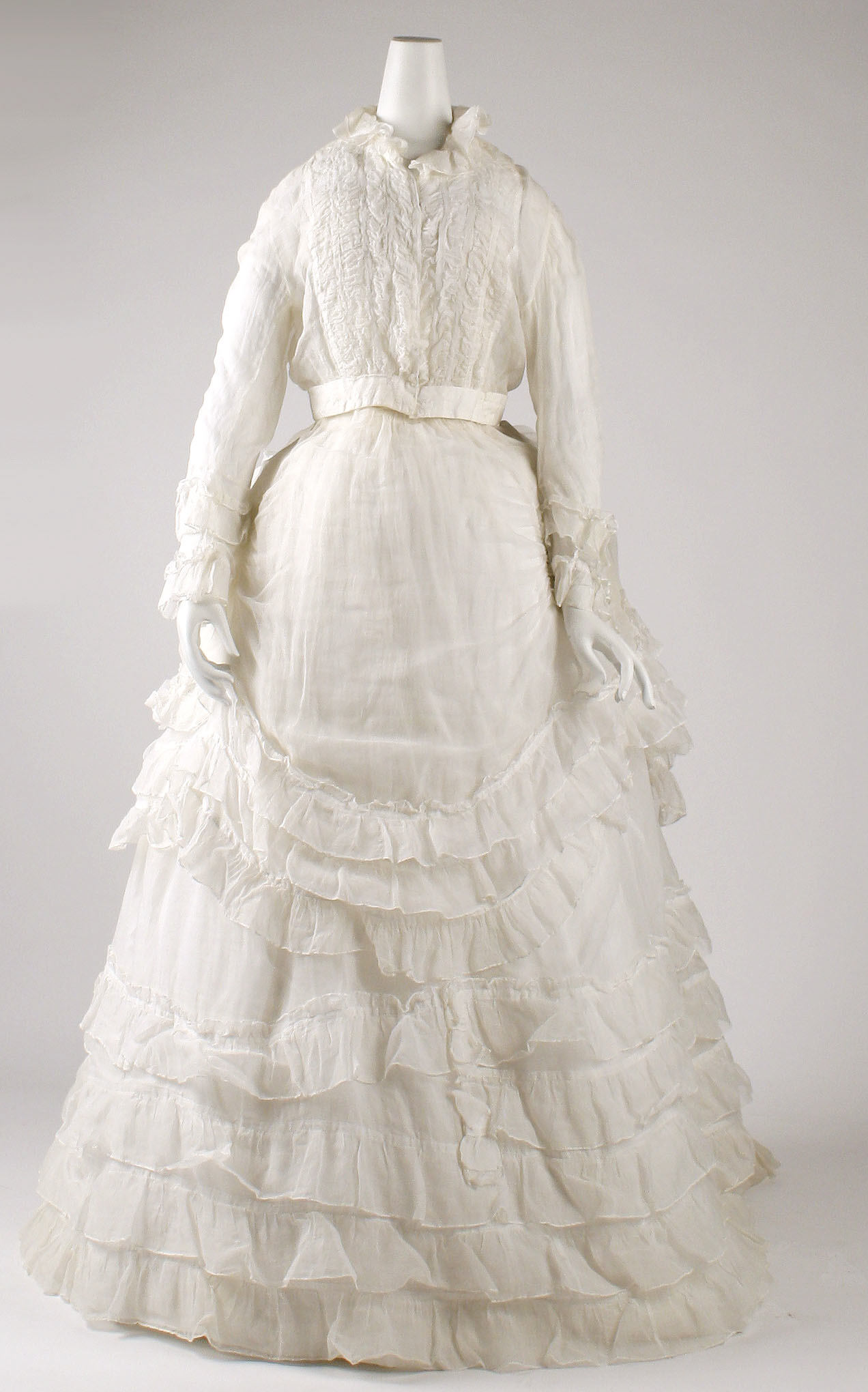
It documents material, silhouette, labor and collection history. A viewer may attach a family story, a film scene or imagined past. That response is valuable, but it must stay separate from the object’s documented history.
03
Autobiographical nostalgia refers to one’s own remembered past. Collective nostalgia concerns a group’s shared story. Retro fashion can also manufacture familiarity through repeated silhouettes, campaigns and media archives, even for people born later. These may overlap. Still, a 1990s revival is no evidence that the viewer remembers the 1990s.
Marketing research can measure preference or purchase intention. It cannot, by itself, establish recovered autobiographical memory or a neural benefit. Fashion history must also ask whose “good old days” are being sold and whose exclusions disappear in the edit.
04
Small fMRI studies of experimentally evoked nostalgia report activity across memory, self-referential, emotion and reward systems. That distributed pattern fits nostalgia’s complexity. It does not locate a nostalgia center, prove that nostalgia is therapeutic, or let a scan authenticate a memory.
Oba et al. (2016), open article ↗ · Yang et al. (2022), open article ↗
WATCH · LISTEN · LEARN
Janata’s public research record and primary studies.
Open research ↗Rachel Herz explains olfaction for a public audience; link-only educational media.
Authorized YouTube page ↗The Met record separates collection history from the associations a viewer supplies.
Museum record ↗CLAIM LEDGER · MEMORY AND NOSTALGIA BOUNDARIES
THE FITTED CLAIM
Autobiographical recall is cue-dependent and entwined with emotion and self.
A garment’s multisensory features may help cue a personally encoded episode.
A special fashion-nostalgia circuit, perfect recall, diagnosis, or universal well-being benefit.