PACKAGE AAN-F-001 · PUBLISHABLE EVIDENCE EDITION
One study opens a claim. It does not close it.
The study everyone quotes. The replication people omit. The boundary an honest fashion story must hold.
The phrase enclothed cognition is unusually seductive. It makes clothing sound like software for the self: put on the correct garment, activate the correct mind. The idea entered popular culture through a 2012 paper by Hajo Adam and Adam D. Galinsky. Its best-known experiment reported that participants wearing a white lab coat made fewer errors on incongruent Stroop trials than participants wearing their own clothes.
That result was about a narrow laboratory task. It did not measure intelligence, IQ, creativity, confidence, professional competence or a changed brain. No brain imaging was performed. The researchers proposed that both the physical experience of wearing the clothing and its symbolic meaning mattered. That is a theory about meaning carried by an object. It does not show that every meaningful outfit reliably upgrades cognition.
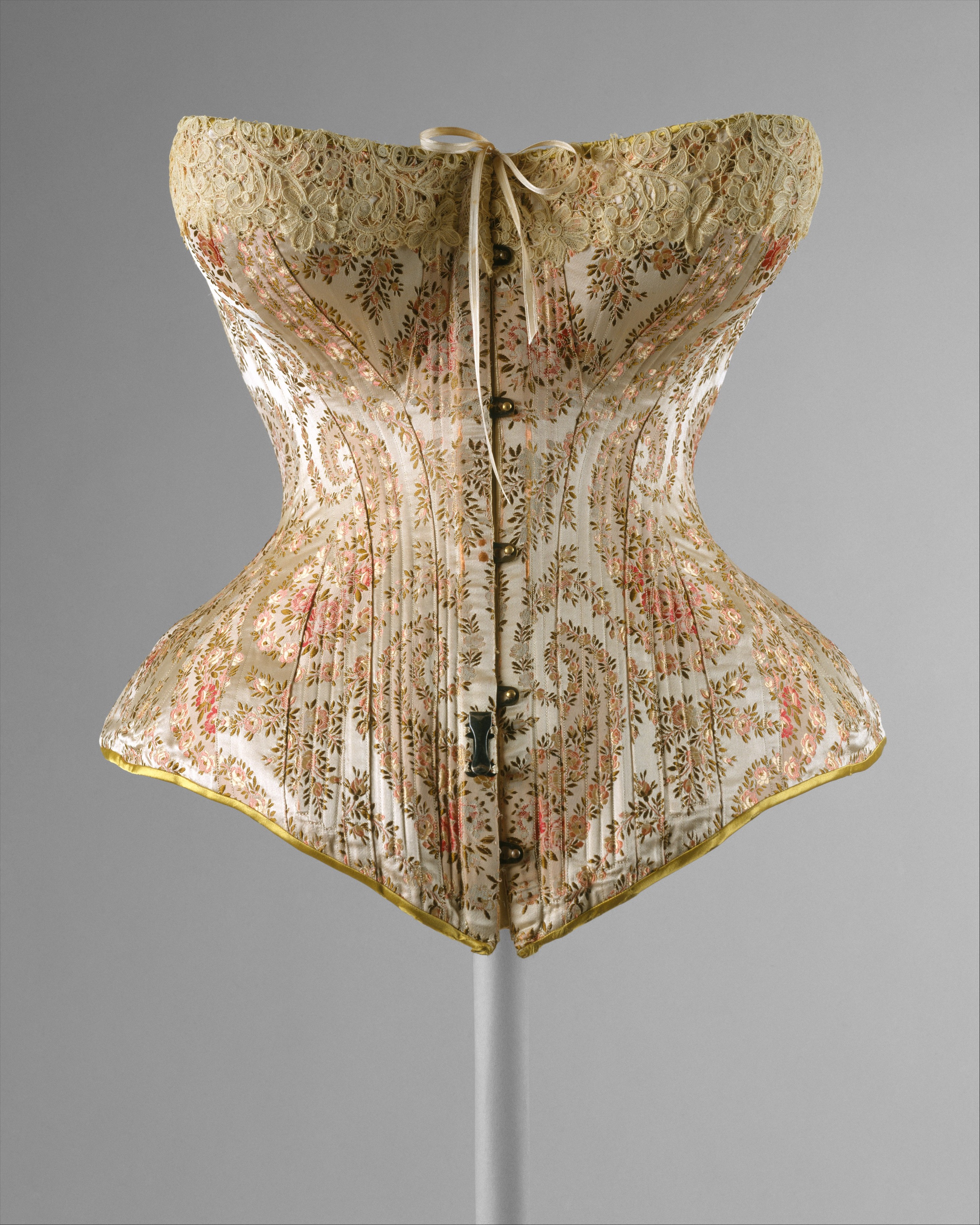
OBJECT I · THE BODY IS ALREADY IN THE EXPERIMENT
A garment is never only a symbol.
A corset is material, pressure, geometry and learned silhouette at once. It can constrain movement without changing attention; it can alter posture without changing belief; it can signal status before the wearer speaks. That complexity is exactly why “clothes change your brain” is too blunt a sentence.
01
What the first study actually claimed
Adam and Galinsky ran three experiments. The paper linked the symbolic meaning of a lab coat with the physical experience of wearing it. In Experiment 1, the relevant reported result was fewer errors on incongruent Stroop trials for people wearing a lab coat. Later experiments used a sustained-attention task and manipulated whether a coat was described as a doctor’s coat or a painter’s coat, or was merely displayed.
The careful sentence is: in this set of experiments, the authors reported task-specific differences associated with wearing a garment and with the meaning assigned to it. The careless sentence is: clothes make you smarter.
What was measured matters more than what the headline implies.
A Stroop task tests interference and selective attention under tightly controlled conditions. Performance on it is not a synonym for intelligence. A statistically significant interaction in one outcome is also not evidence of a permanent or general cognitive transformation.
Primary source: Adam & Galinsky, “Enclothed cognition,” Journal of Experimental Social Psychology 48 (2012). DOI ↗
02
The replication changes the label
In 2019, Devin M. Burns, Elizabeth L. Fox, Michael Greenstein, Gayla R. Olbricht and DeMaris Montgomery published a preregistered direct replication of the original Stroop experiment. The replication did not recover the lab-coat effect. Using equivalence testing and the “small telescopes” framework, the authors argued that if the effect exists, it is too small to have been reliably detected by the original design.
This is stronger than simply saying “a second experiment was nonsignificant.” The replication team also detected theoretically predicted sequential effects as small as seven milliseconds, which made poor technique or an incapable task less persuasive explanations for the null result.
The replication still leaves room for clothing to matter. What it changes is the evidence label on the famous Stroop claim, which moves from demonstrated fact to disputed finding. Other outcomes, garments and contexts require their own tests.
Direct replication: Burns, Fox, Greenstein, Olbricht & Montgomery, Journal of Experimental Social Psychology 83 (2019), 150-156. DOI ↗

OBJECT II · ROLE BEFORE MECHANISM
Clothes can assign a role without proving that cloth changed the brain.
Costume armor can make authority visible, organize another person’s expectations and change the wearer’s possible movements. Those are meaningful effects. They are not interchangeable with a claim about selective attention.
03
What the larger literature can and cannot rescue
C. Blaine Horton Jr., Hajo Adam and Adam D. Galinsky later evaluated the broader enclothed-cognition literature using z-curve and meta-analytic methods. Their analysis supports a more qualified view: the literature contains evidence consistent with some enclothed-cognition effects, while the earliest work showed weaker replicability. The article appeared online in 2023 and in the 2025 issue of Personality and Social Psychology Bulletin.
A meta-analysis cannot make dissimilar garments, manipulations and outcomes identical. It can estimate a pooled pattern; it cannot promise that a particular coat, suit, uniform or pair of shoes will change a particular person’s cognition in everyday life. Publication selection, effect-size variation and the meanings attached to clothing all remain relevant.
Evidence synthesis: Horton, Adam & Galinsky, “Evaluating the Evidence for Enclothed Cognition,” Personality and Social Psychology Bulletin. DOI ↗
04
The nervous system is not alone in the room
A separate 2014 experiment by Michael W. Kraus and Wendy Berry Mendes demonstrates why the social scene matters. Male participants wore business-suit clothing or sweatpants before a negotiation with another participant who did not know the clothing had been assigned. The researchers reported differences in negotiation behavior and physiological measures for wearers, along with vigilance-related physiological responses in their partners.
This was a status-signaling experiment with pairs of people. It did not study the brain directly, and it makes no universal statement about formalwear. It involved male dyads, culturally legible class signals and a modified negotiation task. It nonetheless makes one point vivid: an outfit may operate through other people. Dress changes what the room predicts, permits and returns to the wearer.
Social interaction evidence: Kraus & Mendes, Journal of Experimental Psychology: General 143 (2014), 2330-2340. DOI ↗
THE EVIDENCE-FITTED ANSWER
Can clothes change how you think?
Sometimes clothing may contribute to changes in attention, feeling or conduct, but the effect depends on the garment, its felt properties, its learned meaning, the person, the task and the social environment. The iconic lab-coat Stroop result did not directly replicate. Treat clothing as one part of a larger system that joins the body, meaning and the situation. No garment works as a guaranteed switch for thinking.
Garments provide sensory constraints and social signals. Specific experiments report behavioral and physiological differences under particular manipulations.
A lab coat makes people smarter, formalwear raises IQ, clothing “rewires” the brain, or one result applies to every wearer and context.
Which effects replicate, which mechanisms carry them, how disability and culture change the experience, and what persists outside the laboratory.
CLAIM LEDGER · READ THE BOUNDARY WITH THE FINDING